
ChatGPT said:
REST APIs are fundamental in software development, simplifying communication between web services. Their Client-Server architecture, scalability, and independence make them versatile for various applications. Implementation saves time and money, making them valuable for websites and e-commerce.
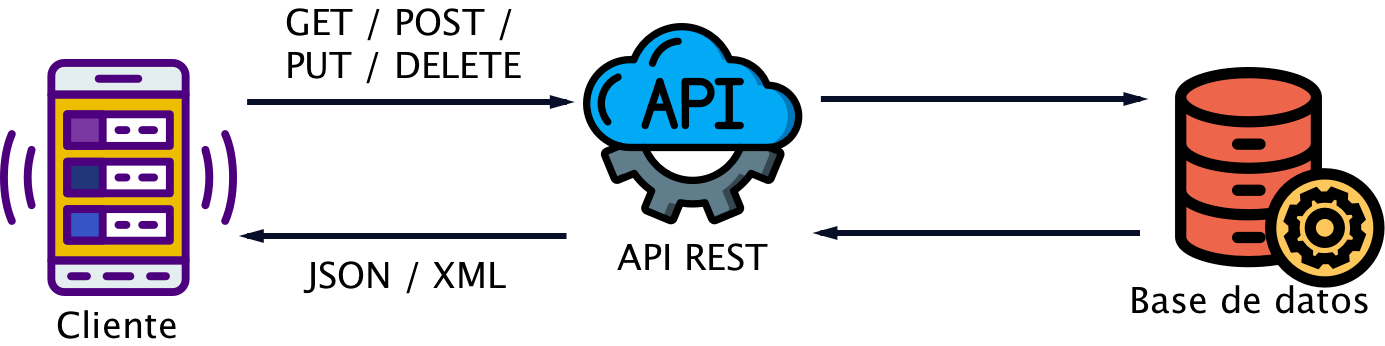
Currently, most companies developing software use REST APIs to create and connect different services, as it is a highly efficient standard for building websites.
To better understand what a REST API is, let’s first explain what an API is. An API is a broad term, generally referring to how one piece of code communicates with another. In web development, an API often refers to the way we retrieve information from an online service. API documentation provides a list of URLs, query parameters, and other information on how to make requests, as well as the type of response each query will return.
For an API to be classified as RESTful, it must adhere to essential principles:
1. Client-Server Structure: The architecture must clearly separate clients, servers, and the resources they exchange, using HTTP for client requests. 2. Stateless Communication: Each request from the client must contain all the information needed to understand it, without the server remembering previous requests. 3. Data Caching: Data can be cached to improve request efficiency, reduce server load, and speed up client responses. 4. Uniform Interface: To ensure standardized information transfer, certain rules must be followed:
- Clear and unique identification of requested resources, separate from the representations sent to the client.
- The representation received by the client must be complete, allowing resource manipulation.
- Messages sent to the client must be self-descriptive, including the information needed for processing.
- Incorporation of hypertext or hypermedia, enabling clients to discover other available actions through hyperlinks.
5. Layered System: Servers processing requests are organized in layers hidden from the client, which may include security or load-balancing functions. 6. Code on Demand (Optional): Ability to transfer executable code from the server to the client to extend functionality.
Unlike stricter protocols like SOAP, which require specific structure and heavier communication, REST follows flexible principles. This flexibility makes RESTful APIs faster, lighter, and adaptable, ideal for IoT applications and mobile development, thanks to their ability to fit diverse needs and contexts.
What is REST?
REST is simply a guiding principle on how to use URLs and the HTTP protocol to structure an API. The term stands for Representational State Transfer, meaning the service does not retain data between calls. For example, a user can be authenticated with their email and password in one request, but the next request will not remember the previous authentication.
So, what is a REST API?
A REST API is a backend capable of responding to calls to a set of URLs in JSON format (a simple text format for data exchange) and can also receive JSON to manage the information sent.
The goal of a REST API is to simplify developers’ work, since creating them does not require coding from scratch, just modifications based on intended use and the type of site. One main function of the API is to communicate with an operating system that has databases or communication protocols.
How does a REST API work?
REST determines the structure of an API. Developers must follow certain rules when designing an API, such as linking a URL to return specific information.
Each URL is a request, while the returned data is the response.
REST APIs break a transaction into a sequence of smaller components, each addressing a specific aspect of the transaction. This modularity makes it a flexible development approach.
Characteristics of a REST API
Client-Server
REST services are based on a Client-Server architecture, with a server containing resources and clients accessing them.
Scalability
REST services can be scaled to handle high demand from many clients. This may involve server farms with load balancing and failover or multiple server levels to minimize response times. Using intermediate servers requires REST clients to send complete, independent information in each request, allowing routing and load balancing without sharing session data.
Independence
A complete, independent request does not require the server to store context or sessions. REST clients must include all parameters, context, and data in HTTP headers and body, increasing performance and simplifying server design, as no session synchronization is needed.
In short, REST APIs are essential in software development, facilitating communication between web services. Their Client-Server architecture, scalability, and independence make them valuable in various contexts. Learn how to implement them efficiently on your website or e-commerce platform.
On what type of website would you use a REST API?
With this information, you should feel encouraged to implement it on your website or e-commerce site.
If you need more information or help with your web pages, remember that Dos Setenta has a team of web developers capable of achieving all your goals. If so… don’t hesitate to contact us!